
past and future global temperatures
Check with seller
Published date: June 4, 2026
- Location: Brookfield, Massachusetts, United States
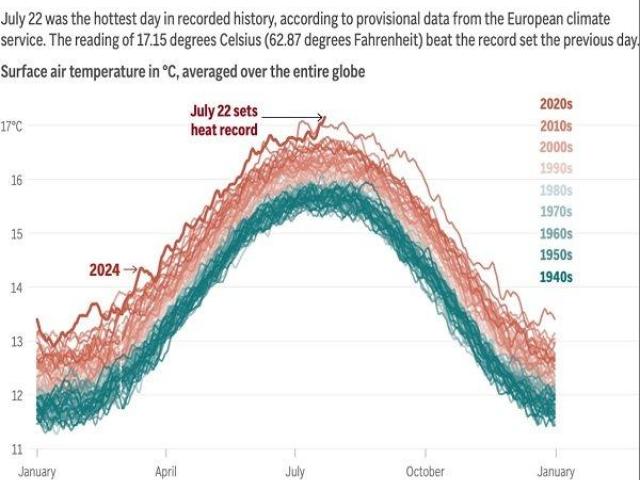
cover (leaving darker water and vegetation exposed), and more water vapor (a major greenhouse gas) in warmer air.
During the ice ages of the past 800,000 years and more, and further back to warmer times for 15 million years before then, Earth’s surface and oceans have warmed and cooled. The relationship between CO2 levels and temperature (with some variation) has been much the same in warmer and colder eras. With today’s CO2 levels in the air, Earth then (say, 14 million years ago) was 5°C hotter than the 20th century average. In the future, if existing trends continue, global temperatures are expected to rise 3-4°C by 2100. This would lead, among other things, to more extreme weather events, rising sea levels, less food and fresh water, and different ecological and socio-economic challenges. Beyond 2100, if CO2 and methane emissions phase out only slowly, due to feedbacks, temperatures are expected to increase to more than 9°C (above 20th century average) by 2400, with CO2 almost 3 times today’s, including feedback (such as thawing permafrost) CO2 and methane increases from warming. If we phase out fossil fuel emissions by 2050, CO2 levels are projected to stabilize at 7°C above the 20th century average. With a strong added effort to cool Earth - featuring CO2 removal and re-brightening Earth (using a mix of the many methods available) - soon enough - temperature rise can be held below 3°C and possibly below 2°C. Visit: https://www.globalwarming-sowhat.com/heat/world
During the ice ages of the past 800,000 years and more, and further back to warmer times for 15 million years before then, Earth’s surface and oceans have warmed and cooled. The relationship between CO2 levels and temperature (with some variation) has been much the same in warmer and colder eras. With today’s CO2 levels in the air, Earth then (say, 14 million years ago) was 5°C hotter than the 20th century average. In the future, if existing trends continue, global temperatures are expected to rise 3-4°C by 2100. This would lead, among other things, to more extreme weather events, rising sea levels, less food and fresh water, and different ecological and socio-economic challenges. Beyond 2100, if CO2 and methane emissions phase out only slowly, due to feedbacks, temperatures are expected to increase to more than 9°C (above 20th century average) by 2400, with CO2 almost 3 times today’s, including feedback (such as thawing permafrost) CO2 and methane increases from warming. If we phase out fossil fuel emissions by 2050, CO2 levels are projected to stabilize at 7°C above the 20th century average. With a strong added effort to cool Earth - featuring CO2 removal and re-brightening Earth (using a mix of the many methods available) - soon enough - temperature rise can be held below 3°C and possibly below 2°C. Visit: https://www.globalwarming-sowhat.com/heat/world
9 page views
Related listings
-
 Full Spectrum Remodeling LLCCheck with sellerOther Services Wilbraham (Massachusetts) June 2, 2026A well-organized project can make updates feel manageable, even when multiple rooms are involved. For many households, kitchen remodeling starts with layout planning, appliance clearances, and durable surfaces, followed by tile work installation that...
 -
 how high will sea level riseCheck with sellerOther Services Brookfield (Massachusetts) May 29, 2026How high will sea level rise? Sea level rose about 6 inches during the 20th century, after rising no more than 1 inch in any of the previous 20 centuries. It rose at a rate of 8 inches per century over 1993-2002, 12 inches per century over the next d...
 -
 Employee Compensation Consulting Services for Clear Pay StructureCheck with sellerOther Services Boston (Massachusetts) May 27, 2026A strong pay structure helps teams stay focused and trust leadership. When pay feels uneven, confusion grows and performance drops. Our Employee Compensation Consulting Services give you a clear way to manage pay across your team. We review how each ...
Check with seller
Contact publisher

Name: GLOBAL WARMING - SO WHAT
E-mail: [email protected]
Phone: +1 7816987176
Contact sellerUseful information
- Avoid scams by acting locally or paying with PayPal
- Never pay with Western Union, Moneygram or other anonymous payment services
- Don't buy or sell outside of your country. Don't accept cashier cheques from outside your country
- This site is never involved in any transaction, and does not handle payments, shipping, guarantee transactions, provide escrow services, or offer "buyer protection" or "seller certification"
Comments
Leave your comment (spam and offensive messages will be removed)